
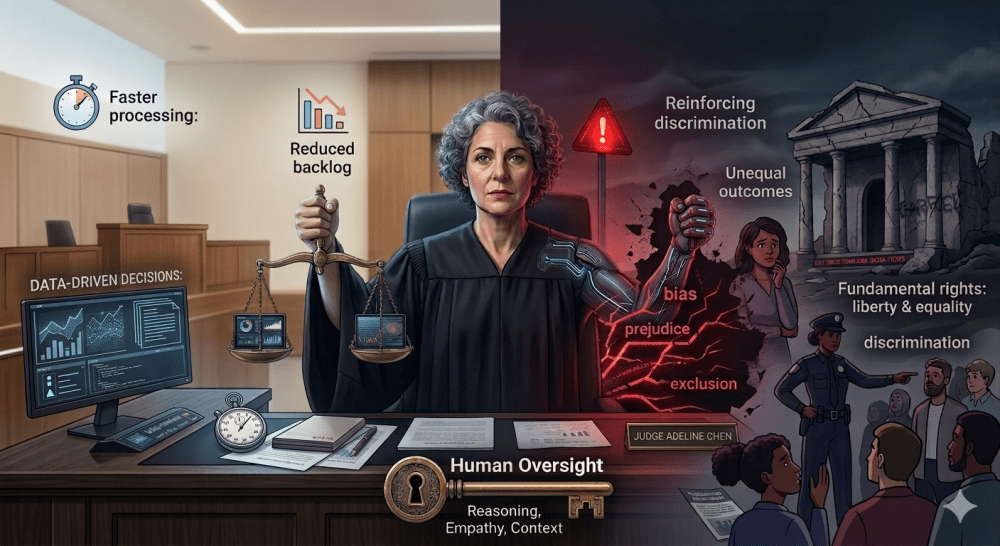
Artificial Intelligence is gradually becoming a part of modern legal systems, assisting in tasks such as legal research, risk assessment, case prediction, and administrative decision-making. Courts and legal institutions are exploring the use of algorithmic tools to improve efficiency and reduce case backlogs, which have long been a challenge in many jurisdictions. These systems are capable of processing large volumes of legal data within a short period of time, thereby enabling quicker analysis and supporting legal professionals in handling complex matters. While such technological advancement appears beneficial, it raises a fundamental legal question: can an algorithm truly deliver fair justice in a system that is deeply rooted in human reasoning and moral judgment? The concern extends beyond technical accuracy and enters the domain of constitutional and legal principles such as equality before law, non-discrimination, and procedural fairness. Justice is not limited to the outcome of a case but also involves the fairness of the process through which that outcome is reached. Legal decision-making requires interpretation of facts, evaluation of evidence, and consideration of circumstances that may not always be quantifiable. Therefore, the integration of AI into legal systems must be carefully examined to ensure that efficiency does not override fairness and that the core values of justice are preserved.
Understanding Bias in AI Systems
Bias in AI refers to systematic discrimination that occurs when an algorithm produces outcomes that unfairly favor or disadvantage certain individuals or groups. These biases often arise because AI systems are trained on historical data, which may reflect existing social inequalities or institutional practices. As a result, the algorithm may learn patterns that are not neutral but are influenced by past human decisions. This creates a situation where the system appears objective on the surface but may actually be reinforcing underlying biases present in the data. In the legal context, such bias becomes particularly concerning because decisions can directly affect fundamental rights, including liberty, equality, and access to justice. Unlike human decision-makers, who can be questioned and held accountable for their reasoning, AI systems may not provide clear explanations for their outputs. This makes it difficult to identify whether a decision is influenced by bias. The perception of objectivity in AI systems can further complicate the issue, as users may place undue trust in algorithmic outputs without critically examining their fairness.
Sources of Algorithmic Bias
The origin of bias in AI systems can be traced to several stages, including data collection, model design, and implementation. One of the most significant sources is the training dataset, which may not accurately represent the diversity of the population. If certain groups are underrepresented or overrepresented, the system may develop skewed patterns that lead to unequal outcomes. Historical data may also include decisions that were influenced by social or institutional prejudice, thereby embedding such bias into the system. Another source of bias lies in the design and structure of the algorithm itself. Developers may make choices regarding which variables to include, how to weigh them, and how to interpret results. These choices, even when made unintentionally, can affect the fairness of the system. Additionally, some variables used in algorithms may act as indirect indicators of sensitive attributes, leading to discriminatory outcomes without explicitly using prohibited factors. These complexities demonstrate that bias in AI is not always obvious and requires careful analysis to detect and mitigate.
Impact on Legal Decision-Making
The presence of bias in AI systems can have serious consequences in legal decision-making, particularly when such systems are used to support or influence critical outcomes. In areas such as bail determination, sentencing recommendations, and risk assessment, algorithmic outputs may directly affect an individual’s rights and freedoms. If the system produces biased results, it may lead to decisions that are not only unfair but also inconsistent with legal principles of equality and justice. Such outcomes can undermine public trust in the legal system, as individuals may perceive decisions to be influenced by hidden or unaccountable processes. The scale at which AI operates further increases the risk, as biased patterns can be applied across a large number of cases. This creates the possibility of systemic discrimination, where certain groups are consistently disadvantaged. Unlike isolated human errors, algorithmic bias can become entrenched within the system, making it more difficult to identify and correct.
Fairness and the Rule of Law
Fairness is a fundamental requirement of the rule of law, ensuring that all individuals are treated equally and without discrimination. In the context of AI, achieving fairness is a complex task, as different definitions of fairness may lead to different outcomes. For example, ensuring equal treatment may conflict with the need to account for individual circumstances. Legal systems must therefore determine how fairness should be defined and implemented in algorithmic decision-making. This challenge is further complicated by the need to align AI systems with established legal doctrines such as natural justice, which requires that decisions be made impartially and with proper reasoning. If AI systems fail to meet these standards, their use may be inconsistent with the principles of the legal system. Ensuring fairness in AI requires a careful balance between technical design and legal requirements, with a focus on protecting individual rights and maintaining the integrity of the justice system.
Challenges of Transparency and Explainability
Transparency is an essential aspect of legal decision-making, as it ensures that decisions can be understood, reviewed, and challenged. However, many AI systems operate in a manner that lacks transparency, particularly when complex models are used. These systems may produce outputs without providing a clear explanation of how those outputs were generated. This creates a significant challenge in legal contexts, where reasoning and justification are necessary components of a valid decision. The lack of explainability can also affect the ability of individuals to exercise their legal rights. If a person is adversely affected by an AI-assisted decision, they have the right to know the basis of that decision and to challenge it if necessary. Without clear explanations, this right may be compromised. Furthermore, legal professionals may find it difficult to rely on AI systems if they cannot understand the reasoning behind the results. Addressing this issue requires the development of AI systems that are not only accurate but also capable of providing clear and understandable explanations.
Accountability in Algorithmic Decision-Making
Accountability is a cornerstone of the legal system, ensuring that decision-makers can be held responsible for their actions. In the context of AI, establishing accountability becomes more complex, as decisions may involve multiple actors, including developers, organizations, and legal professionals. When an AI system produces an incorrect or biased outcome, it may be difficult to determine who is responsible for the resulting harm. This lack of clarity can create challenges in enforcing legal remedies and maintaining trust in the system. Without clear accountability, individuals affected by biased decisions may have limited options for seeking redress. It is therefore essential to establish legal frameworks that define responsibility at each stage of the AI lifecycle, from development to deployment and use. Such frameworks should ensure that accountability is clearly assigned and that appropriate mechanisms are in place to address errors and prevent misuse.
Possibility of Mitigating Bias
Although bias in AI systems presents significant challenges, it is possible to mitigate these issues through appropriate measures. One approach involves improving the quality and diversity of training data to ensure that it accurately represents different groups and perspectives. Regular audits and evaluations can also help identify patterns of bias and enable corrective action. Additionally, incorporating fairness constraints into algorithm design can reduce the likelihood of discriminatory outcomes. Legal and regulatory oversight plays a crucial role in this process, as it ensures that AI systems comply with established standards and principles. Human involvement remains essential, as legal professionals must review and interpret AI outputs rather than relying on them blindly. By combining technical improvements with legal safeguards, it is possible to reduce bias and enhance the reliability of AI systems in legal decision-making.
Balancing Efficiency and Justice
AI systems offer significant benefits in terms of efficiency, consistency, and the ability to handle large volumes of data. These advantages can help address delays and improve the overall functioning of the legal system. However, the pursuit of efficiency must not come at the expense of justice. Legal decision-making involves complex human elements, including empathy, moral judgment, and contextual understanding, which cannot be fully replicated by algorithms. Over-reliance on AI may lead to a reduction in these human elements, resulting in decisions that are technically accurate but lack fairness and sensitivity. It is therefore important to maintain a balance between the use of technology and the preservation of human judgment. AI should be used as a supportive tool that enhances the capabilities of legal professionals, rather than replacing their role in decision-making.
Conclusion
The question of whether algorithms can deliver fair justice remains a subject of ongoing debate. While AI has the potential to improve the efficiency and consistency of legal processes, it also introduces risks related to bias, transparency, and accountability. These challenges highlight the need for careful regulation and responsible use of technology in the legal domain. Ensuring fair justice requires a commitment to upholding fundamental legal principles, including equality, fairness, and respect for individual rights. AI can contribute to these objectives if it is designed and implemented with appropriate safeguards. However, it cannot replace the role of human judgment and legal reasoning, which are essential to the administration of justice. The future of AI in law depends on the ability to integrate technological innovation with the core values of the legal system, ensuring that progress does not compromise justice.